


This article summarises key trigonometric identities. We classify these identities into two groups:
- Identities proved using the definitions of trigonometric functions
- Identities proved using the addition formulae
This classification will help you recall the methods of proof later on.
1 Definitions of Trigonometric Functions
The main trigonometric functions are sine (sin), cosine (cos), and tangent (tan). Using a circle with radius r and a point A(x, y) on its circumference, as shown in Figure 1, we define the trigonometric functions as in Definition 1.
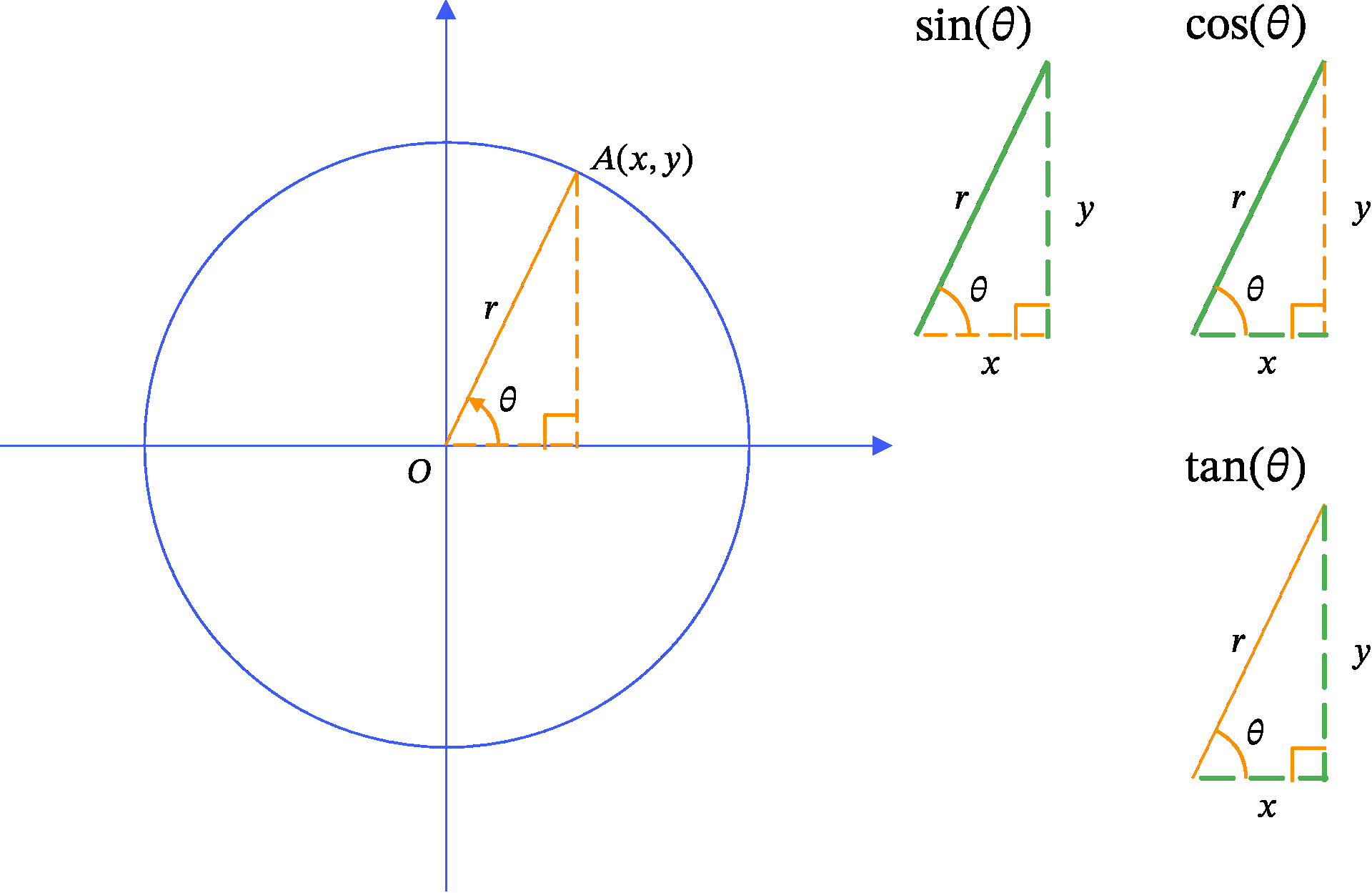
Definition 1 (Definitions of Trigonometric Functions) \begin{aligned} \sin(\theta) &= \frac{y}{r}\\ \cos(\theta) &= \frac{x}{r}\\ \tan(\theta) &= \frac{y}{x} \end{aligned}
These definitions form the foundation of all trigonometric functions.
2 Trigonometric Identities Proven from Definitions
Here are identities that we can prove directly from the definitions:
\sin^2{\theta} + \cos^2{\theta} = 1 \tag{1}
\tan(\theta) = \frac{\sin{\theta}}{\cos{\theta}} \tag{2}
1 + \tan^2{\theta} = \frac{1}{\cos^2{\theta}} \tag{3}
\sin{(-\theta)} = -\sin{\theta} \tag{4}
\cos{(-\theta)} = \cos{\theta} \tag{5}
\tan{(-\theta)} = -\tan{\theta} \tag{6}
\sin{(\pi - \theta)} = \sin{\theta} \tag{7}
\cos{(\pi - \theta)} = -\cos{\theta} \tag{8}
\tan{(\pi - \theta)} = -\tan{\theta} \tag{9}
\sin{\left(\frac{\pi}{2} - \theta \right)} = \cos{\theta} \tag{10}
\cos{\left(\frac{\pi}{2} - \theta \right)} = \sin{\theta} \tag{11}
\tan{\left(\frac{\pi}{2} - \theta \right)} = \frac{1}{\tan{\theta}} \tag{12}
3 Addition Formulae
The addition formulae are essential tools that connect trigonometric functions of different angles. They are expressed as follows:
Theorem 1 (Addition Formulae)
- \sin(A + B) = \sin A \cos B + \cos A \sin B
- \cos(A + B) = \cos A \cos B - \sin A \sin B
- \tan(A + B) = \frac{\tan A + \tan B}{1 - \tan A \tan B}
You often see the addition formulae written for angles A-B. Simply substituting B with -B in Theorem 1 proves this case, so we omit it here.
Alongside the definitions, the addition formulae serve as the foundation for deriving many other identities. It is important to memorise them.
4 Identities Derived from the Addition Formulae
Using the addition formulae, we can derive the following identities.
Double-angle identities
\sin{2\theta} = 2\sin\theta \cos\theta \tag{13}
\cos{2\theta} = \cos^2\theta - \sin^2\theta = 2\cos^2\theta - 1 = 1 - 2\sin^2\theta \tag{14}
\tan{2\theta} = \frac{2\tan\theta}{1 - \tan^2\theta} \quad (1 - \tan^2\theta \neq 0) \tag{15}
Half-angle identities
\sin ^{2}\dfrac{\alpha }{2}=\frac{1 - \cos \alpha }{2} \tag{16}
\cos ^{2}\dfrac{\alpha }{2}=\dfrac{1+\cos \alpha }{2} \tag{17}
\tan ^{2}\dfrac{\alpha }{2}=\dfrac{1-\cos \alpha }{1+\cos \alpha } \tag{18}
Linear Combination of sine and cosine
a\sin \theta + b\cos \theta =\sqrt{a^{2}+b^{2}} \sin \left( \theta +\alpha \right) \tag{19}
, where
\begin{aligned} \cos \alpha &= \dfrac{a}{\sqrt{a^{2}+b^{2}}},\\ \sin \alpha &= \dfrac{b}{\sqrt{a^{2}+b^{2}}}. \end{aligned}
5 Understanding Is More Important Than Memorisation
While it is convenient to memorise identities, I strongly recommend that you do not rely on rote memorisation without understanding. The proofs of trigonometric identities involve important techniques and ways of thinking in this field, which exceed mere memorisation.
Certainly, when preparing for exams, it helps to know the identities to some extent. However, the best way to remember them naturally is to use them repeatedly. If you find you cannot remember the identities even when solving problems, you are probably not practicing enough. Rather than relying on memorisation, try to solve enough problems until the identities come to you naturally.
In conclusion, I recommend the approach of “repeatedly proving to understand the identities deeply while practising problems regularly to internalise them.”


