


This article provides an explanation of the definitions of trigonometric functions. As this definition forms the basis of all trigonometric functions, it is essential to understand it thoroughly. Furthermore, by grasping these definitions, one does not need to memorise specific trigonometric values, such as \sin \left( \frac{\pi}{4} \right).
1 Definition of Trigonometric Functions
There are mainly three trigonometric functions: sine (sin), cosine (cos), and tangent (tan). Initially, these functions represent the ratios of sides in a right-angled triangle. However, this premise restricts the angles to acute angles (from 0^\circ to 90^\circ). Therefore, to handle a more general range of angles, trigonometric functions are defined using a circle, as depicted in Figure 1.
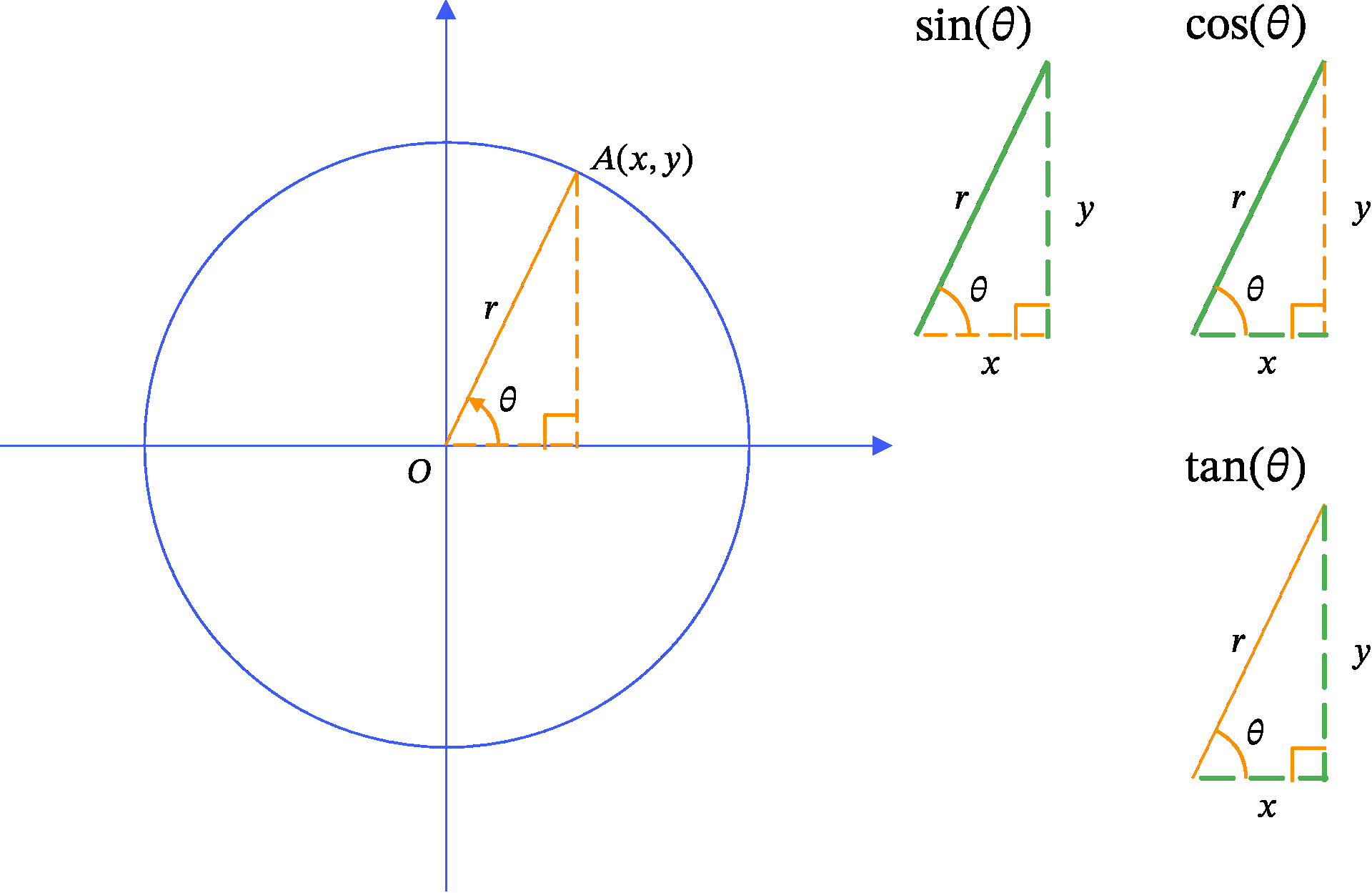
In Figure 1, the circle and points are plotted following these steps:
- Draw a circle with its centre at the origin O and a radius of r.
- Arbitrarily add a point A on the circumference of this circle. Let the coordinates of this point be (x, y).
- Draw a line segment OA with endpoints at point A and the centre of the circle.
- Define the angle between the x-axis and the line segment OA as \theta. At this point, \theta is measured counterclockwise from the positive direction of the x-axis.
We will now define the trigonometric functions based on the combinations of r, x, y, and \theta:
Definition 1 (Definition of Trigonometric Functions) \begin{aligned} \sin \theta &= \frac{y}{r}\\ \cos \theta &= \frac{x}{r}\\ \tan \theta &= \frac{y}{x} \end{aligned}
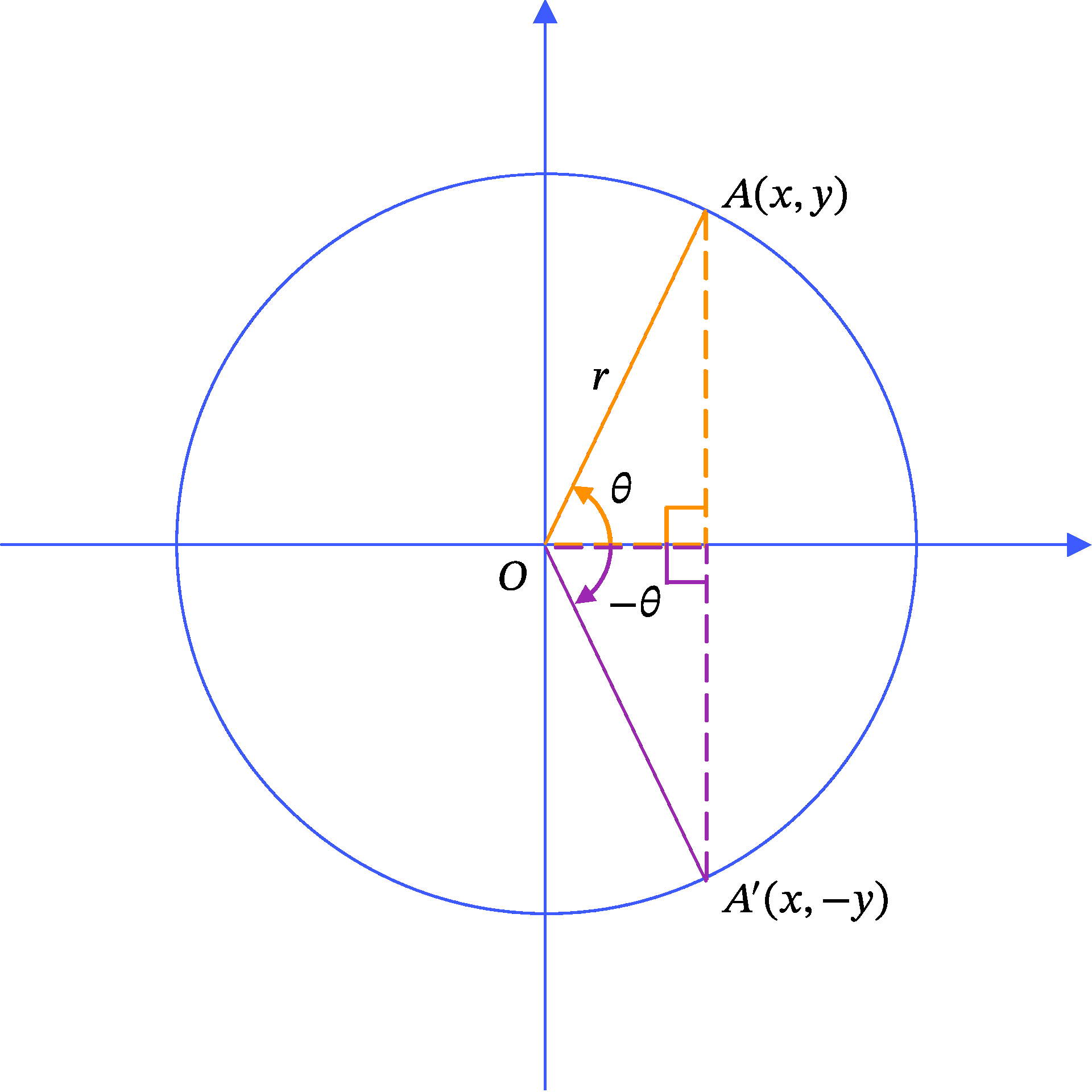
This definition simply measures \theta counterclockwise from the positive direction of the x-axis, allowing \theta to take on angles such as 120^\circ, 360^\circ, or even larger values. Conversely, it is also possible to measure angles clockwise from the positive direction of the x-axis. Let us define counterclockwise angles as positive angles and clockwise angles as negative angles. In Figure 2, the angle \theta with a positive value is determined by the x-axis and the line segment OA, while the angle with a negative value, -\theta, is determined by the x-axis and the line segment OA'.
2 Relationship between x, y, and \theta
In the context of Definition 1, the following relationship holds between x, y, and \theta:
r^2 = x^2 + y^2 \Leftrightarrow r = \sqrt{x^2 + y^2}.
Considering the right-angled triangle in Figure 1 and applying the Pythagorean theorem, we can easily derive this. Since r > 0, it follows that r = \sqrt{x^2 + y^2}.
Additionally, from Definition 1, if we multiply both sides of \sin \theta = \frac{y}{r} by r, we obtain y = r \sin \theta. Similarly, since \cos \theta = \frac{x}{r}, we find x = r \cos \theta:
\begin{aligned} x &= r \cos \theta,\\ y &= r \sin \theta. \end{aligned}
From this equation, it is evident that the x-coordinate and y-coordinate can be expressed in terms of r and \theta. This perspective becomes significant in polar coordinates.
3 Definition of Trigonometric Functions Using the Unit Circle
In Definition 1, we used a circle with radius r. In some texts, a unit circle may be employed instead (a unit circle is one with a radius of 1). In fact, since the values of trigonometric functions do not depend on the radius of the circle, it is perfectly valid to use any radius, as we did in Definition 1, or to use a radius of 1.
4 Using the Definition to Calculate Representative Values of Trigonometric Functions
Typically, a calculator is required to determine the values of trigonometric functions. However, for certain angles, it is possible to easily find the values of trigonometric functions using Definition 1. For instance, let us consider the case where \theta = 0.


When \theta = 0
In Figure 3 (a), we consider a circle with radius r. At this point, the point on the circumference corresponding to \theta = 0 is located at A(r, 0). We can substitute this coordinate and the radius into Definition 1 to calculate the values of the trigonometric functions.
\begin{aligned} \sin 0 &= \frac{y}{r} = \frac{0}{r} = 0, \\ \cos 0 &= \frac{x}{r} = \frac{r}{r} = 1, \\ \tan 0 &= \frac{0}{r} = 0. \end{aligned}
Utilising the definition, we were able to easily determine the value.
When \theta = \frac{\pi}{3}
Let us explore the values of the trigonometric functions in the case of \theta = \frac{\pi}{3}. We can refer to the scenario illustrated in Figure 3 (b). Since \frac{\pi}{3} is equivalent to 60^\circ, we consider a right triangle with side ratios of 1 : 2 : \sqrt{3}.
As we discussed in Section 3, the values of trigonometric functions do not depend on the radius. In simpler terms, we can apply trigonometric functions to circles of any radius. For this example, we will take the radius as r = 2, which allows us to determine that the coordinates of point A, corresponding to \theta = \frac{\pi}{3}, are (1, \sqrt{3}).
Thus, we can calculate the values of the trigonometric functions as follows:
\begin{aligned} \sin \frac{\pi}{3} &= \frac{y}{r} = \frac{\sqrt{3}}{2}, \\ \cos \frac{\pi}{3} &= \frac{x}{r} = \frac{1}{2}, \\ \tan \frac{\pi}{3} &= \frac{\sqrt{3}}{1} = \sqrt{3}. \end{aligned}
Tip 1: TIP: Calculating the Values of Trigonometric Functions Using the Definition
In the definition, we can use convenient values for the radius of the circle.
- For angles such as \frac{\pi}{6}, \frac{\pi}{3}, \frac{2\pi}{3}, \frac{5\pi}{6}: radius 2
- For angles such as \frac{\pi}{4}, \frac{3\pi}{4}: radius \sqrt{2}
This time, we used a radius of 2, but for cases like \frac{\pi}{4}, it is advisable to consider an isosceles right triangle and use \sqrt{2}.

By using the definition of trigonometric functions in this manner, you can easily determine their values, so there is no need to memorise them. Instead, it is beneficial to become accustomed to the process of deriving values using the definition.
5 Range of Values the Trigonometric Functions Can Take
From the definition of trigonometric functions Definition 1, we can understand the possible values of the trigonometric functions.
5.1 Range of Values for Sine
Firstly, sine is defined as follows:
\sin \theta = \frac{y}{r}.
Since r is a constant (fixed value), the sine value is determined by the y coordinate of the point on the circumference. In the definition based on right triangles, the values of the sides were positive, so the values of the trigonometric ratios were always positive. In contrast, in this definition, as shown in Figure 1, the y coordinate can be positive, negative, or zero. Therefore, sine can take positive and negative values, as well as zero.
Now, can sine take any positive or negative value? The y coordinate here refers specifically to the y coordinate of the point on the circumference shown in Figure 1. From this diagram, we can see that the value of y must satisfy -r \leq y \leq r. Thus, y can have a maximum value equal to the radius r and a minimum value of -r.
Consequently, \sin \theta = \frac{y}{r} can take values in the following range:
\frac{-r}{r} \leq \frac{y}{r} \leq \frac{r}{r}.
Thus, we can conclude that -1 \leq \sin \theta \leq 1.
5.2 Range of Values for Cosine
Similarly to sine, we can consider cosine as well. Since the definition of cosine is \cos \theta = \frac{x}{r}, let us examine the range of values for x. From Figure 1, we have:
-r \leq x \leq r.
Thus, we can conclude that:
\frac{-r}{r} \leq \frac{x}{r} \leq \frac{r}{r}.
From this, we find that -1 \leq \cos \theta \leq 1. It is evident that cosine takes the same range of values as sine.
5.3 Range of Values for Tangent
Tangent, unlike sine and cosine, is defined as \tan \theta = \frac{y}{x} using both x and y, which necessitates a more complex understanding. To put it simply, tangent can take any real value. In other words, it can achieve both very large and very small values.
I will explain the range of values for tangent, but if you find it complicated, you may skip ahead to the next section.
5.3.1 When \theta Approaches \frac{\pi}{2} from Below
Consider the case where \theta is slightly less than \frac{\pi}{2}, for example, \theta = \frac{\pi}{2} - 0.1, and it gradually approaches \frac{\pi}{2}. In this situation, as illustrated in Figure 1, the point on the circumference moves closer to (0, r), which is directly above the origin.
The value of y will only reach a maximum of r. Conversely, as \theta approaches \frac{\pi}{2}, the value of x remains positive while getting closer to 0, meaning it approaches increasingly small positive values.
For instance, let us assume it takes the following small positive values:
\frac{1}{10}, \frac{1}{100}, \frac{1}{1000}, \frac{1}{10000}, \ldots
At this moment, within the definition of tangent \tan \theta = \frac{y}{x} = t \times \frac{1}{x}, the value of \frac{1}{x} will be the reciprocals of the aforementioned numbers:
10, 100, 1000, 10000, \ldots
Thus, as the value of x decreases, \frac{1}{x} in the definition of tangent increasingly assumes larger values. Consequently, tangent can take values that grow indefinitely large.
From this, we can conclude that tangent can take any positive value. Additionally, since \tan 0 = 0, tangent also takes the value 0.
5.3.2 When \theta Approaches \frac{\pi}{2} from Above
Conversely, let us consider the scenario where \theta approaches \frac{\pi}{2} from a value such as \frac{\pi}{2} + 0.1, which is greater than \frac{\pi}{2}.
In this case, as before, y will only assume values up to r. However, x approaches 0, but unlike before, x will take negative values. Therefore, \frac{1}{x} will be:
-10, -100, -1000, -10000, \ldots
While the absolute value increases, it remains negative. Hence, tangent can take increasingly small values (with increasing absolute value) and can attain indefinitely small negative values.
Thus, we can confirm that tangent can take any real number value.
5.4 Summary of the Range of Values for Trigonometric Functions
In summary, sine and cosine take values between -1 and 1, while tangent can take any real number value.
6 Tips for Future Learning
Understanding the definition of trigonometric functions is essential for further study, as it will be referenced repeatedly in the future. Particularly, by becoming accustomed to the method of calculating typical values of trigonometric functions using the definition, you will deepen your understanding of the definition itself, eliminating the need to memorise the values of trigonometric functions. It is advisable to practice calculating values using the definition.


